Violence, The Bloom, and Making Shit Up as You Go
Author Note: My running of The Bloom using Violence was before rules for modern paranormal investigation and horror were added to the ruleset. I have presented my brief little session reports at the bottom of the post as well for historical posterity.

So after running a few Delta Green scenarios, the classic Last Things Last and Reverb, and with a hell of a lot of time running Call of Cthulhu scenarios, nearly a year into my group’s Impossible Landscapes run, I wanted to do something different. The relative “Traditional” play culture that Call of Cthulhu encapsulates will always be a first love, but as my interests have grown, the more “free-wheeling” OSR and FKR styles of play have been much more interesting veins to mine, with their focus on player-led, emergent storytelling, problem solving, and lack of balance.
So with this type of ethos of “playing the world” and “rulings not rules”, I wanted to stretch beyond the typical Delta Green mechanics, or rather pick and choose which ones I felt worked and were “useful” at a table and discard others, add new ones, and in essence create my own little Frankenstein-esque creation and test it out.
Rules Choices & Why
Combat Rules
I’ve been a big fan of Luke Gearing’s work for some time; his fabulous Wolves Upon the Coast game, his work on Swyvers, Acid Death Fantasy, and in the extremely evocative The Isle all really scratch that its of inhabiting a unique world with its own diegetic ideas and mechanics that assist in achieving “playing the world”.
A perusal of his blog found his own creation of a “fast, nasty system for violence resolution,” aptly titled Violence, which seems to be partially inspired by the early Western TTRPG Boot Hill and, in particular, this blog post.
In essence, this combat system is more about the fatality of getting hit; weapons lack inherent damage values because any weapon can kill. It's a simple, streamlined system that revolves around simple d20 rolls with a few modifiers depending on the type of gun used, training, etc.
Already, the idea that these mechanics implicitly provide is unique: they create situations with a high likelihood of fatality, prompting players to reconsider when the threat of violence against them (their PCs) by NPCs is just as punitive.
Monster Stats
So the first part of my Frankenstein was found; I removed the RAW combat mechanics of DG and replaced them with these. I was even more pleasantly surprised when I found that Luke had a similar idea in mind and continued to develop and flesh this out with what I would call a “supplement” to the Violence rules, Inhuman Violence.
Again in Gearing’s own words, “I’ve been running a Delta Green campaign using Violence for a little while now” and found that his original Inhuman Violence rules were lacking, so he went back to the drawing board and dropped this little gem of wisdom
Rather than having a single unified way to model damage for the supernatural, each creature should have its own unique damage model. This increases the amount of work required, but should give much richer results - and due to the lower count of monsters in most horror games (as compared to fantasy) this shouldn’t be too much work. It also roots us once again in the fictional nature of the being - forcing us to consider how alien flesh might react to physical trauma.
So once again by happy accident, the second part was found: monster stats! While I had an idea for the module (which I will flesh out a bit more in the appropriate section), the general monster with the module closely aligned with Gearing’s The Dead, albeit with a few style tweaks.
Stat block provided below for reference.
THE DEAD1
Flesh borrowed or robbed from rightful rest. What festers within? An animus against the living carried all life long. Or an imposter that would puppet flesh with no concern for the mind that once dwelt within. Or simply the will of another killing the mind and hollowing the body to be worn as you might put on a suit.
Evasion: +3 (No evasive moves taken.)
Shooting: 20/per weapon.
Melee: 2d6. Always receives one Injury as it fights without self-preservation. Adds +1d6 for each additional Dead assisting.
Harm: Whenever the Dead are Injured or Downed, roll 1d6 on the table below. Keep track of their Injuries.
| xd6 | Result |
|---|---|
| 1-20 | The Dead rise up despite their horrific injuries. When rolling on this table again, add 1d6. |
| 21+ | The Dead goes down, body rendered useless. |
With the creature stated out there was one more thing that I had to create in addition to using the stat above. The monster (and various iterations - a cougar form, a bear form, a deer form, and a large mass form) in the module is essentially a fungal zombie, think the Cordyceps virus in The Last of Us, so with that in mind, the idea of the risk of contagion and how to model that became a question.
Luckily, a different Delta Green scenario dealt with this exact issue. The module in mind is Extremophila written by Shane Ivey, which deals with otherworldly fungal infections. Within that module, there is a section entitled “Contagion” that has some procedural rules for dealing with if a player character ends up contracting the infection, with this flavor text
“Exposure to a victim under control of the unnatural contagion may lead to contamination as the alien flora spreads. Contamination instills unnatural thoughts and instincts…”
With this model and Violence rules as a framework, I kit-bashed them together to create my own unique rules for Contagion. See below.
Exposure to a victim under the control of the unnatural contagion may lead to contamination as the Bloom spreads. Contamination instills unnatural thoughts and instincts.
| Disease | Route | Speed | Damage | Symptoms |
|---|---|---|---|---|
| The Bloom | Inhaled or Ingested | 24 Hours | 1 SAN, Fallout, 1d4 WP | Fever, Headache, Confusion |
» Close contact (such as a fight, or a conversation inside a vehicle or at very close quarters) or extended but somewhat protected contact (such as providing first aid, or a conversation in a living room) calls for a Luck roll to escape contamination.
» Surgery or an internal medical examination calls for a Luck roll at a −20% penalty.
» An ordinary surgical mask by itself offers no protection. Wearing a surgical mask with full-body scrubs and gloves, or a filter mask, grants a +20% bonus to the Luck roll. Wearing a hazmat suit protects the victim fully.
Every 24 hours after infection, the victim must make a d20 roll, DV 15 roll.
- Failure costs the victim 1 SAN, 1d4 WP, and earns them a Fallout as the Bloom influences the victim’s brain and body.
- If the daily d20 roll succeeds, the victim is able to ward off infection.
Under Bloom Control
When reduced to 1 WP, the victim comes under mental control of the Bloom and becomes a Host enemy NPC. The victim recovers 1D4 WP per day, but loses 1D6 SAN per day as alien thoughts and instincts take over.
Character Creation & Skills
Because of the inherent die-or-don’t nature of Violence rules, the traditional way that Delta Green uses character generation wasn’t needed. It needed to be streamlined and adapted for d20 rolls instead of the d% roll under system that the game traditionally uses.
With that in mind, I got rid of HP (given the lethality) and kept Willpower, Sanity, Breaking Points, and Bonds as useful stats and mechanics, as I wanted to keep most of the Sanity rules from Delta Green intact.
However, I switched Willpower and Bond score to use 4d6, drop the lowest, as Delta Green already uses this method for stat creation.
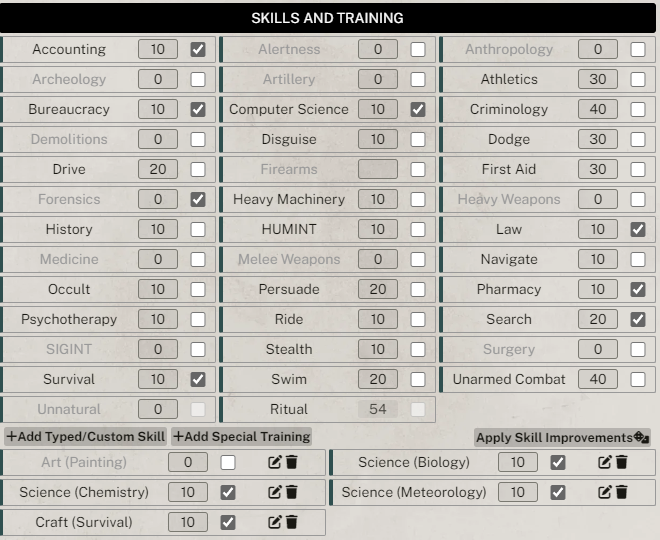
The other major overhaul to character creation is to still use the profession choices as guide rails for character creation but not have players set numerical values for said stats, just whether or not their profession had them or not.
I made this decision in mind to lessen the need for dice rolls and allowing for more roleplaying. My thinking is that if your day job requires these skills by default, you are competent, if not an expert, in them already, thus negating the use for a dice roll for say “Search” or “Law”.
The obvious flip side is that if a player character isn’t trained in a particular skill, it would then necessitate a d20 roll with a DC set in accordance with the Violence rules, or if operating under a particular stressful situation, then even your core competencies would need a roll.
Thus, character sheets are quite bare-bones and look like the image below
Sanity Rules
The breaking point was kept as Sanity minus Willpower, and I kept all the same sanity mechanics intact, as I feel that Delta Green has a bit more streamlined sanity resolution system than Call of Cthulhu.
With the majority of the heavy lifting done, the system I had smashed together from Gearing’s Violence, bits and pieces of DG mechanics, and the OSR ethos of playing the character, not the character sheet, achieved a few things at least theoretically. It would have to be put into practice.
It emphasized the quick and brutal nature of violence, a de-emphasis on rolling dice and more role-playing that still allowed characters to shine in their particular ways in accordance with their skill sets, and monster stats that felt unique and possessed a genuine threat. The next piece of the puzzle was to choose an appropriate module that wasn’t a traditional Delta Green scenario, yet open enough in its own ways to allow for this kit-bashed ruleset.
The Module
Billed as “What if Twin Peaks had a Last of Us arc?” Goblin Archive’s module The Bloom is specifically built for Liminal Horror, a hack of Into the Odd which places emphasis more on everyday characters encountering horrors in a modern-day setting compared to those in state-power structures like Delta Green.
The module is a sandbox adventure and indeed it is capable of being played in multiple ways, however, for my use I chose the missing hikers angle and to flavor this extended play test even more different, I set-dressed the scenario as occurring in Canada and used the Delta Green Canadian counterparts M-EPIC as the choice of investigator for my players, and in true sandbox fashion after the “inciting incident” the players essentially pick and choose what leads to follow.
One of the module’s (as well as Liminal Horror’s) more unique points is the concept of Fallout, which serves to narratively reinforce the module’s themes and aims via a change in a player’s physical, emotional, or mental state2.
A highlight of this module is its use of a “doom clock” and what the module calls a “voidcrawl”. For those unfamiliar, a “doom clock” is just a sequence of escalating narrative elements that will occur “off-screen” and helps maintain tension over the course of the module3.
A “voidcrawl” is just the module’s random encounter table, which they break up into four distinct parts of the day: Morning, Midday, Evening, Night, with certain tables “locked” depending upon the day. Again, it acts as a way to maintain tension and suspense over the course of the module4.
Given the minimal prep needed, self-contained scenario doomsday countdown, and open-world nature of the module, The Bloom made a perfect choice to use a testing ground for the kit-bashed rules.
Characters
Due to the unique nature of where I placed the campaign and the parameters given, I gave my players some above-table knowledge about just what M-EPIC is and how it differs from the Conspiracy-minded Delta Green agents.
In short, M-EPIC…

“is the M-division of the Environmental Policy Impact Commission (M-EPIC) is an official Canadian federal agency tasked with investigating paranormal activities within the Canadian borders.
M-EPIC has a fraction of the personnel and resources available that most governmental organizations have, and yet they have responsibility for a significantly larger area, much of it remote and inhospitable.
Secondly, M-EPIC is an actual legitimate badged law enforcement agency. Whilst its true purpose is secret, it does have a mandated jurisdiction, and the public might even have heard of it.
Its agents have (within particular parameters) the ability to arrest and prosecute, order around other organizations, and generally do things that you'd expect federal agents to do.
M-EPIC agents don't tend to use cover identities, as they are usually using their legitimate authority to get things done. That doesn't mean they don't go outside the law or cover things up, but they have far more ability to do things "by the book" than Delta Green”
They are essentially a known governmental agency that isn’t relatively well-known but assists in natural wildlife service, parks and recreation, EPA-style roles and the like, but as cover for investigating the unnatural. This obviously hems in the types of professions that M-EPIC chooses from but also slots nicely into the outdoorsy nature of the Bloom module.
After some research, I found these Canadian agencies are likely the best candidates to recruit from for M-EPIC..
RCMP = Royal Canadian Mounted Police aka "The Mounties"
JTF-2 = Joint Task Force-2 aka Counter Terrorism units ala Delta Force
Environment and Climate Change Canada = The Canadian EPA
Public Health Agency of Canada = The Canadian CDC Centre for Emergency Preparedness and Response (CEPR)
Dept. of Fisheries and Oceans = A sub-dept of Canada's version of the US Wildlife Service
Canadian Wildlife Services = A near 1:1 match of the US Wildlife Service and a child branch of the ECCC.
With the character parameters and lore in place, my player group went with a Mountie and two agents from the Dept of Fisheries and Oceans, with one leaning more into what's called the Bio Resources Division, which “works to support parks in restoring and maintaining healthy ecosystems” via monitoring and measuring wildlife health, works for conservation efforts, and finally landscape restoration and adaptation. All in all, the player group really leaned into the setting given its uniqueness5.
Session Reports
Session 1
- Inciting incident - learned about the hikers and other missing persons case
- Met the deputy and sheriff
- Interviewed the park ranger - Sasquatch red herring
- Strange markings on cabin, glowing mushrooms, moldy knife, broken camera, bullet casings, two cars - one from missing campers with tires deflated and another that's been sitting since spring
- Head back to town, eat pizza and one of them gets sick and notices gray oyster mushrooms growing out of the toilet sides
Session 2
- Blueberry festival in full swing given shitty weather
- Got coffee and met Kassandra, got binoculars for some reason, pissed off the businessman, went to find an NPC to ask them for her GF’s help in search and rescue, found a furry trout, investigated another car, found an abandoned homestead with some other clues that pointed them to the Station
- Went to the station and interviewed Raimi and then proceeded to arrest him via the drums of AN sitting outside next to a gas station in the rain
- Had to find the regulations for AN storage per Canada’s law after players followed that clue to the Station
- Also found that Canada doesn’t have Miranda Rights but what’s called the Charter of Rights and Freedoms. To my surprise, I found that at least in Canada, one does NOT have the right to have a lawyer present during questioning
- Ended the session on them arresting the NPC for the above issue, then blackmailing him to frame him for domestic terrorism for his silence after he saw them shoot an infected individual and roll the infected’s car into the embankment. They then proceeded to light the car on fire, which drew the attention of the deputy sheriff, who found the car belonged to an out-of-towner. The said infected person broke out of the car’s driver's side window and is on the loose.
- Weather is extremely shitty and will wash out the only road in or out
Session 3
- Started slow as folks drifted in from real-life duties
- Picked up in the aftermath of the shooting
- Gerald and John talk; John intimates the car on fire being for insurance
- Dermot attempts to find clues, finds nothing of true value - but wants to look at the suitcase of clothes later - used roll table
- Kayla investigates the tire tracks and finds a paw print in the mud near the end of the paved road - cougar howl in the dark - VOIDCRAWL
- Beth from the Station picks the car up and takes it back to the Station - did to add tension there in case they come back
- Gang goes back, eats late breakfast at the Cafe and debriefs at the hotel - clues - finds out about Noah (chevy van), digital camera - Pickman’s Lodge / Angela / Brett, ask the front desk for a boom box and listen to the cassette - simple jungle mixtape but think there’s something more there
- Plan next steps -
- Next day, Kayla and John are asked by Hank to help direct traffic - could have run a bit better
- John learns phones are down from Gerald
- Kayla learns a bit more about the Hanson Brothers
- Dermot investigates the Hanson Bros and learns of the Hines Incident - phones are down - rolls a crit - basically intimated that Hank is involved, no coroner's report, and more shady shit.
- They link back up; Dermot tells them about the Hines farm and incident; they go to the cemetery and find more dug-up graves, a white film over the lake, Diego’s car still in the parking lot
- Can’t recall why they wanted to go to the Firewatch tower (Kayla learning about the Hanson brothers partying there??) to find it torn up, the map. Find a pager and the Gateway Tapes - introduced the Prana Sodality - which may or may not be the parent-org to the Church of Celestial Science to throw another red herring in the mix
- Return back to the hotel - plan next steps again - Kayla and John show signs of infection - Dermot runs to the co-op to look for ant-fungals - as last-minute scare I had Shaun, the infected, show back up and stumble out into the woods and attack the urgent care center! FADE TO BLACK
Session 4
- Opens with Dermot seeing the dude kill Jeanne, the doctor
- Fires and runs; Host Shaun follows
- Kayla hears and runs off - not telling John
- Kayla sees Dermot being chased and fires - missing. Dermot jumps off the bridge, landing hard
- The Host closes the distance, and Kayla beats the thing to death; Dermot swims to shore
- John is finally alerted, and the group spends 6 hours cleaning up the evidence and burying the bodies
- Kayla and John go to the Camp and find it claimed, and fight Sam the Park Ranger
- Arrive back into the town and alert Hank and Jeanie, the Mayor
- The group quarantines the Clinic and uses it as a testing and isolation facility
- Dermot finds that John isn't infected, but Kayla is
- Dermot begins work to try and find a cure or a way to slow it down
- Extreme fire, cold kill the mycelium
- Over-the-counter antifungals don't work
- The strongest yeast infection cream slows down spread but only for a short time
- Staying indoors and closing windows can mitigate spread
- Dry spots are needed
- Hazmat and N95 masks are optimal PPE
- It spreads via close contact, inhalation, or ingestion.
- Kayla slathers herself with the yeast infection cream and attempts to sleep, and notices her skin hardening and cracking with red welts. Nails are yellowing
- John goes to the Church of Celestial Science and learns about the Prana Sodality, Dr. Randolph Stone, and meets Timothy. Hints at missing people
- The group reconvenes as Dermot races against the clock and John and Kayla sleep as the Firewatch Tower becomes Claimed.
Session 5
Two encounters with fungal-infected individuals have put the M-EPIC trio on the defensive. They convince the Mayor and Sheriff to close access to Camp Coldwater after dealing with infected Park Ranger Sam and outsider Shaun, as well as disposing of the town's only doctor, Jeanne, after she was killed by the infected Shaun.
Taking over the Coldwater Clinic, they establish a testing and isolation facility, discovering Kayla's infection. With time running out, Dermot races to find a remedy while John alerts town leaders to stay indoors and remain calm.
Session 6
Dermot races to find a cure to no avail as resources and equipment just aren't available in Coldwater. The rain finally relents as the Mayor holds a large gathering in the town square. Tensions are on edge as more and more people have gone missing and tourists are scrambling to leave come hell or high water. Kayla's symptoms seem to have subsided, but the infection remains, and a deeper calling can be heard in the back of her mind, pulling her towards Camp Coldwater.
John and Dermot need antifungal agents, and Dermot suggests the Hines Farm given the agricultural lean of the town. Heading there, the two find the Barn claimed and rotting but find a possible source of the fungal spread, opting to burn the barn down when suddenly an infected bear charges out of the woods and attacks.
Back in Coldwater, a dazed and confused Sarah finds Kayla, who shoots Sarah and flees into the Northern Surrounds, trying to answer a call from Camp Coldwater. John and Dermot escape with their lives as the bear rushes back into the woods only to find Sheriff Hank explaining the death of Sarah at the hands of Kayla.
With pressure mounting and Kayla's actions likely influenced by the fungal infection, Dermot and John can track Kayla down and neutralize the threat. With M-EPIC down to two members and the infection rapidly spreading, can M-EPIC truly save Coldwater?
Session 7
As the infection spreads, Coldwater descends into chaos. Sarah and Kayla's bodies are stored while Dermot and John confer with Sheriff Hank. Overhearing their conversation, a mycologist named Dana Masterson offers her expertise to the M-EPIC agents.
Dana identifies the fungus as a Cordyceps variant while Dermot and John investigate Sarah's house, discovering eerie clues. Meanwhile, Dana hears a noise from the morgue and alerts a deputy, who contacts Dermot and John.
Returning, they find Kayla has turned into a Host and attacks them, fatally injuring Dermot. John orders the deputies to bring a wood chipper for disposal as he deals with the infected.
Elsewhere, Deputy Cyrus Yates and Dana head to the gas station for supplies, finding it overrun with bodies and fungal growth. They hurry back as The Infected Bear emerges from the woods, coinciding with looting and random gunshots happening in Coldwater.
Realizing the caves beneath the town are the source, the trio prepares for a final stand, descending into the Throne Room to confront the infection
Session 8
A quicker session than most as the trio of Cyrus, Dana, and John head into the mines and encounter a few of the Infected. They had lucky rolls, but finally made it into the den where the Anthromycin was there, chased them into the heart of the Bloom, where they proceeded to set fire to the Bloom and die in the process.6
I struggled with how to exactly model the Dead. For example, they get shot and suffer an injury; therefore, they roll 1d6 on the table. Next time they get another injury so that's 2d6 (or would it just be 1d6 again?). According to the first entry, I would add another 2d6 to the roll since it's now the second time rolling on the table for a total of 3d6 (4d6 in my use method). It's been a bit confusing, so I’ve been counting each injury as an xd6 + the number of times rolled on the table as another xd6, which seems to put a Dead down after 4 injuries (8d6 total)↩
This Fallout mechanic is easily grafted onto Delta Green’s pre-existing Sanity rules, while being unique enough to reinforce the unique dangers of the scenario and how they manifest. I went so far as to include it as part of the Contagion rules I wrote as well.↩
So far I’ve found this lends a certain loose structure to maintain a narrative momentum and keep the players from bogging down with analysis paralysis as they are self-selecting which leads to follow.↩
I’ve found myself rolling these events before the session as quick notes and will move them around accordingly if need be. With only three sessions in, it has worked so far, with the second session ending on a nice note that signaled to the trio of investigators that something is wrong within the town of Coldwater.↩
My thinking is that if this module were placed in a more traditional Delta Green setting, the player choices would have to be slightly corralled compared to M-EPIC’s more natural world leanings, it's still possible to insert them as federal agents to search for the missing hikers, but given the fungal infection angle, a lot of the scenario would be lost upon more traditional DG agents without some GM guidance.↩
I teased the black pyramidal sculpture; the skeleton had to be tied to the Church of Celestial Science / the Prana Sodality from DG's The Labyrinth↩